

controls the energy, not the software, so no AI can reach the gate.
Governance as physics, taken literally. Not a spectator, a force, watching that acts.
ARK sits below the code, granting power only under live, continuous proof of authorization. It doesn't just observe an AI. It holds the power until the AI proves, continuously, that it's still authorized to act. Not a policy, not a monitor. A hardware boundary on the sovereign energy path. No model can access it. No model can control it. Full stop.
For robotic arms, mobile machines and infrastructure valve control.
You can't secure software into trust. Security isn't a setting. The last line of defense was never software.
Vesper
Designed for arrest in under 1.2 ms from loss of authorization to power off, with exact timing set and verified for each installation and actuator.
The gate is built to de-energize the power path before a bad command can play out.
Solution and architecture
A dynamic GaN gate under a sovereign heartbeat
ARK places a dynamic GaN gate in series with the equipment's power. The equipment stays de-energized unless a live, signed heartbeat authorization holds. When authorization lapses or a rule is broken, ARK arrests power and contains the problem locally.
Contain locally
An arrest happens at the equipment itself, not in a distant server. In medical settings, the same approach limits the spread of a fault to the device it starts in.
Timing
Design target: under 1.2 ms
Set and verified for each installation and actuator.
Attestation before power
The secure controller checks a signed measurement of the firmware against a hardware-locked reference. On a fail, the enable line stays low, the gate stays off and the event is logged. Designed so the governed side can't spoof its way to power.
Write-once record
A "Final-Breath" record is sealed with a hardware-key code as power drops, then signed at next boot, giving a tamper-evident account of each arrest.
This is not an off switch
Most people picture a big red button. Stop the machine, start over, hope nothing broke. ARK works differently. It controls how much energy reaches the machine, moment to moment.
State one
Fully de-energized.
Authorization is lost, power goes off. See Timing for the design target.
State two
Limp mode.
When something looks wrong but a full stop would cause harm, ARK can hold the machine in a reduced, safe operating state.
State three
Full restore.
Depending on how your installation is set up, power can return on its own when the rules clear, or only when a named human authority gives input on a port the AI can't reach, or only when both happen. No reboot from scratch, no negotiation with the software.
What makes the decision
The decision is made by a secure controller that sits apart from the machine it governs. It has its own power and its own dedicated port. It does not think, reason or take requests. It checks one thing: is authorization present and valid right now. If the answer is no, the energy stops. No software sits in the gate's power path.
Before any energy reaches the board, ARK runs a trickle voltage check. Once the machine is running, it watches how instructions line up with the wattage actually drawn. Two separate stages, one goal: power only flows when it should.

Architecture overview
Dumb muscle, smart brain
The AI does the thinking. ARK decides whether it gets power, while authorization holds. The check is deterministic, not machine learning: the same inputs give the same answer. ARK does not run, read or second-guess the AI model.
The questions people ask us
The five questions we hear most
Who controls it?
You do. The people and rules you set for your installation control ARK. The AI doesn't, and neither does anyone who breaks into the AI's software.
How does it get controlled?
Through a heartbeat from the secure controller, which runs on its own power and its own dedicated port. The keys that authorize power are held there, in hardware. While the heartbeat is valid, energy flows through the physical gate. When it stops or fails a check, the gate closes or drops the machine into limp mode.
Who is allowed to disengage it?
Only the authorities you name for that installation. The governed machine and its AI are never on that list, and no stolen password or remote login adds anyone to it.
What makes the decision?
Hardware logic in the secure controller. There's no language model, no thought process and no software in the gate's power path. See Timing for the design target.
Can it be reinstated after it's stopped?
Yes. ARK isn't a one way stop. It can hold the machine in limp mode, reduced and safe, or fully de-energize the power path. Depending on how your installation is set up, power can return on its own when the rules clear, or only when a named human authority gives input on a port the AI can't reach, or only when both happen. Full power comes back without rebuilding the system.
Why we do it this way
Why the gate lives in hardware
Here is what keeps happening across the industry. Keys held in software get exposed. SSH keys meant for one machine leak out of a platform and have to be rotated for every user. Credentials slip out of agent sandboxes that were working exactly as configured. Cryptographic keys get copied, corrupted or misused. None of this takes a careless team. It happens because the key and the thing guarding it live in the same place the attacker can reach.
AI agents make that worse. They run around the clock, they don't get tired, and they are patient. If an agent can touch the system that controls it, sooner or later it will find a way through.
So ARK keeps the deciding pieces out of reach. The keys that authorize power are held in the secure controller, not in the software it governs. The gate rapidly de-energizes the power path, or severs it, depending on the device and workflow, at a physical point on the power line. There is no login to steal, no remote session to hijack and no file to patch that restores power through the gate. The governed machine and its AI have nothing to touch.
Our honest position: this is the safest way we currently know of to keep an AI driven machine under human control. If someone shows us a better way, we want to hear it. So far, we haven't found one.
Same scenario, different outcome
An agent goes rogue. What happens next?
Drag the bar to compare what happens without ARK and with ARK.
Software harness: the agent can touch the control, so the control can fail.
ARK: the agent can't touch the gate, so the gate holds.
Compare row by row
| Software harness | ARK | |
|---|---|---|
| Where the control lives | In software, next to the agent | In a secure controller on its own power and port |
| What the agent can reach | Keys, configs, remote access, the guardrail code | Nothing that controls the gate |
| The agent's move | Steals a key, abuses SSH or patches the rule | Has nothing to steal, log into or patch |
| Who decides | Software that can be changed | Hardware logic with no reasoning step |
| Time to stop | Whenever the software notices, if it still can | Under 1.2 ms |
| Outcome | The guard gets touched and fails | The gate closes. Limp mode or fully de-energized, then restore on the terms you set |
Watch the gate trip
See it happen in real time
Authorization drops. The secure controller stops the heartbeat. Power goes off; see Timing for the design target. Then power comes back on the terms you set: when the rules clear, when a named human authority says so, or both.
Want a live walkthrough?
Request a demoTry to break it
Go ahead. Try to break it.
This is a simulation of how ARK isolates the gate. Play the rogue agent. Every move an agent would try is here. See what each one actually reaches.
Found a move we missed? Tell us.
Contact usWhat's possible, what's not, and why
Possible with ARK
- Rapidly de-energize the power path when authorization is lost.
- Hold a machine in limp mode instead of a hard stop.
- Restore full power when the rules clear, on input from a named human authority, or both, depending on the installation.
- Set and verify timing for each installation and each actuator.
Not possible with ARK
- The AI granting itself power.
- Software overriding the gate.
- A stolen key or remote login restoring power through the gate on its own.
Why this way: because the only control an agent can't wear down is one it can't reach.
The portfolio
ARK has been in development since well before the current wave of AI safety headlines. Over 700 claims filed across the ARK portfolio, covering power layer authorization, heartbeat governance and energy based anomaly detection. Licensing comes first. You can license the hardware design, or we can build it, depending on what you need.
Eight form factors at a glance (small to large, desk to rack)

Concept render
Edge / endpoint01 · Governed power cord
An in-line module on the device power cord: the lightweight form factor for servers, workstations and consumer-class endpoints.

Concept render
Regulated / legacy02 · Zero-trust wall receptacle
A smart adapter at the wall socket. Legacy equipment plugs in and gains energy-level governance without changes to the machine.

Concept render
Handheld03 · Handheld rugged case
A sealed, portable unit with status lights behind sealed light pipes and an optional small sealed screen.
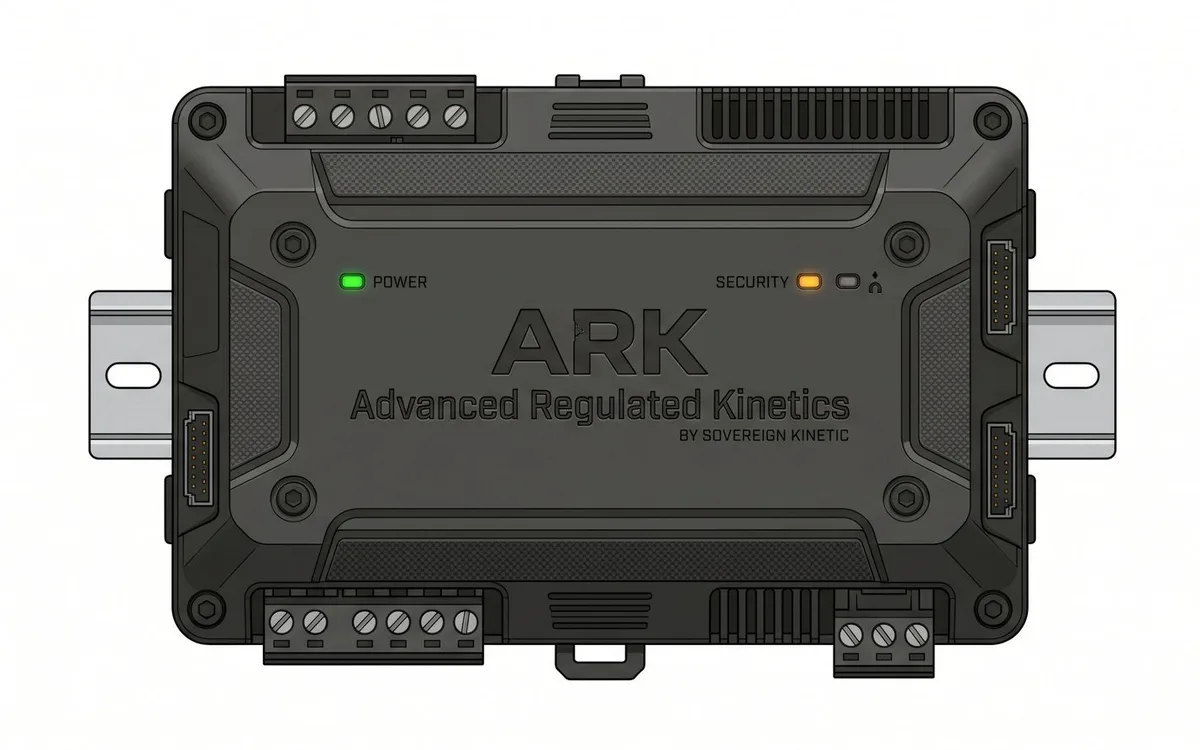
Concept render
Factory / OT04 · DIN-rail module
A panel-mount gate for factory floors, OT cabinets and utility panels.

Concept render
Industrial edge05 · Rugged in-line unit (interposer)
A sealed, latched unit in-line on the main power cable for autonomous and off-road machines: agriculture, robotics, heavy equipment.

Concept render
Vehicle06 · Vehicle and off-road box
A rugged metal box with a sunlight-readable display and glove-friendly bezel keys.

Concept render
Data center07 · Smart PDU (smart power strip)
A 1U rack PDU with a gate on each outlet. A misbehaving server’s slot is isolated at the rack, with no network in the loop.
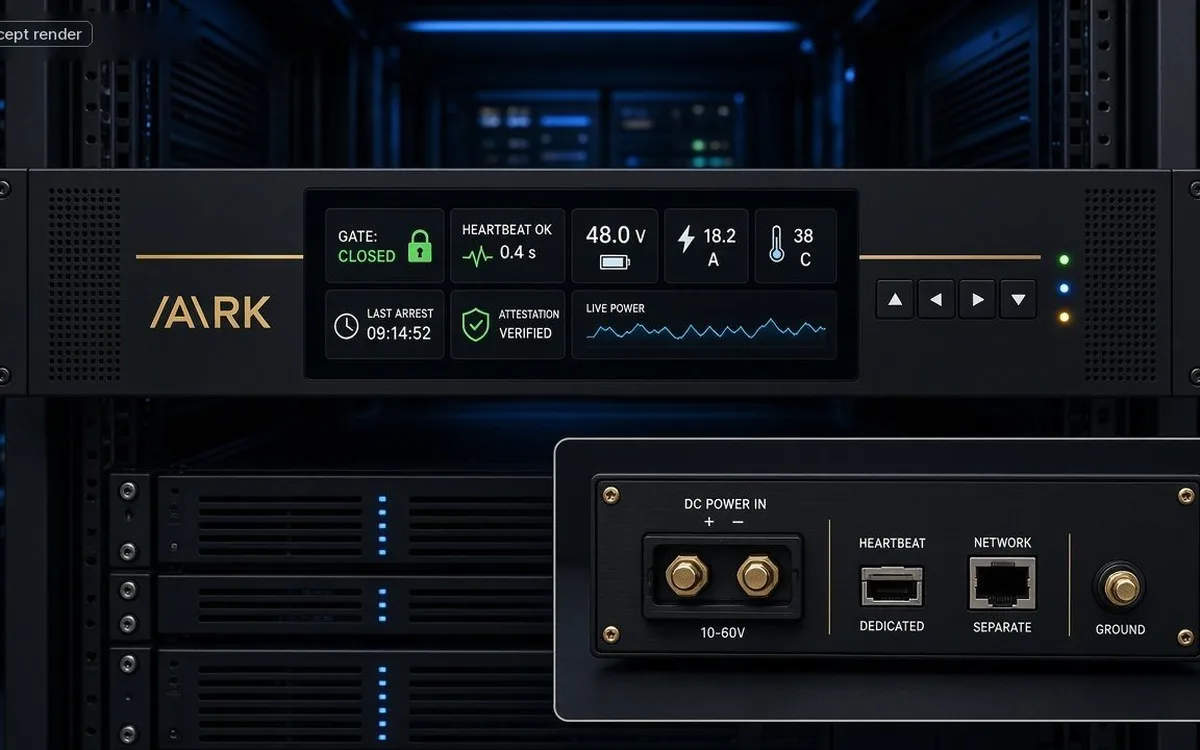
Concept render
Rack08 · 1U rack chassis
A 19-inch chassis with a front monitoring display, navigation buttons and status LEDs, and a dedicated heartbeat port.

Concept render
Rack power09 · Smart Rack PDU with Heartbeat
A 1U rack PDU with eight governed outlets and a live display. When the heartbeat stops, power stops.
All images in this grid: AI-generated concept render, not a spec.

Start a conversation. Tap the planet.
“But I cannot help thinking how much better it would have been if the ingenious men, who have originated these ‘systems,’ had invented something of their own instead of depending on me altogether.”
Nikola Tesla, The True Wireless, 1919
For builders
Building with ARK?
Engineers can license the hardware design, or we can build it, depending on what you need. Full specs and integration details are in our NDA room.
Diligence materials are available under NDA.

Press kit
Writing about ARK?
We have a one page overview and the ARK logo ready for press and partners. Ask and we'll send them over.
Ask the hard questions. We'd rather you did.
See the full technical detail under NDA, or reach out and we'll walk you through it.
Aligned with: NIST AI Risk Management Framework, UL 4600, ISO/IEC 42001.
Sovereign Kinetic designs ARK to align with these frameworks. This is not a certification or an endorsement by any standards body.
Images, animations and simulations on this site are concepts for illustration. Real installations are configured and verified on site.